


Select the sector of your interest


Testimonial about the success of the contact center company Sitel, which operates in two locations in Managua.
July 12, 2014
Published by The Economist
Citizens’ security is the region’s biggest problem. Time to improve criminal justice
PEDRO RODRÍGUEZ, head of Nicaragua’s youth-affairs police, grabs the shoulder of 17-year-old Axel Matus and gives it a shake. “He was one of our worst cases,” he says. In most of Latin America, a youth with Axel’s background—gangs, drugs, knife-fights, joblessness—would cringe at such attention from a burly police commander. But Axel stands bolt upright and admits: “My life was utter chaos.”
Not any more. Axel now attends the Juvenile Affairs police headquarters in Managua, where he is given free meals and tuition every day. Besides subjects like maths and English, he is learning how to be a barber (his blade skills now applied with scissors). Hundreds of troubled kids voluntarily study with him, and the police chief knows most of them by name. They are neatly dressed and ooze self-esteem.
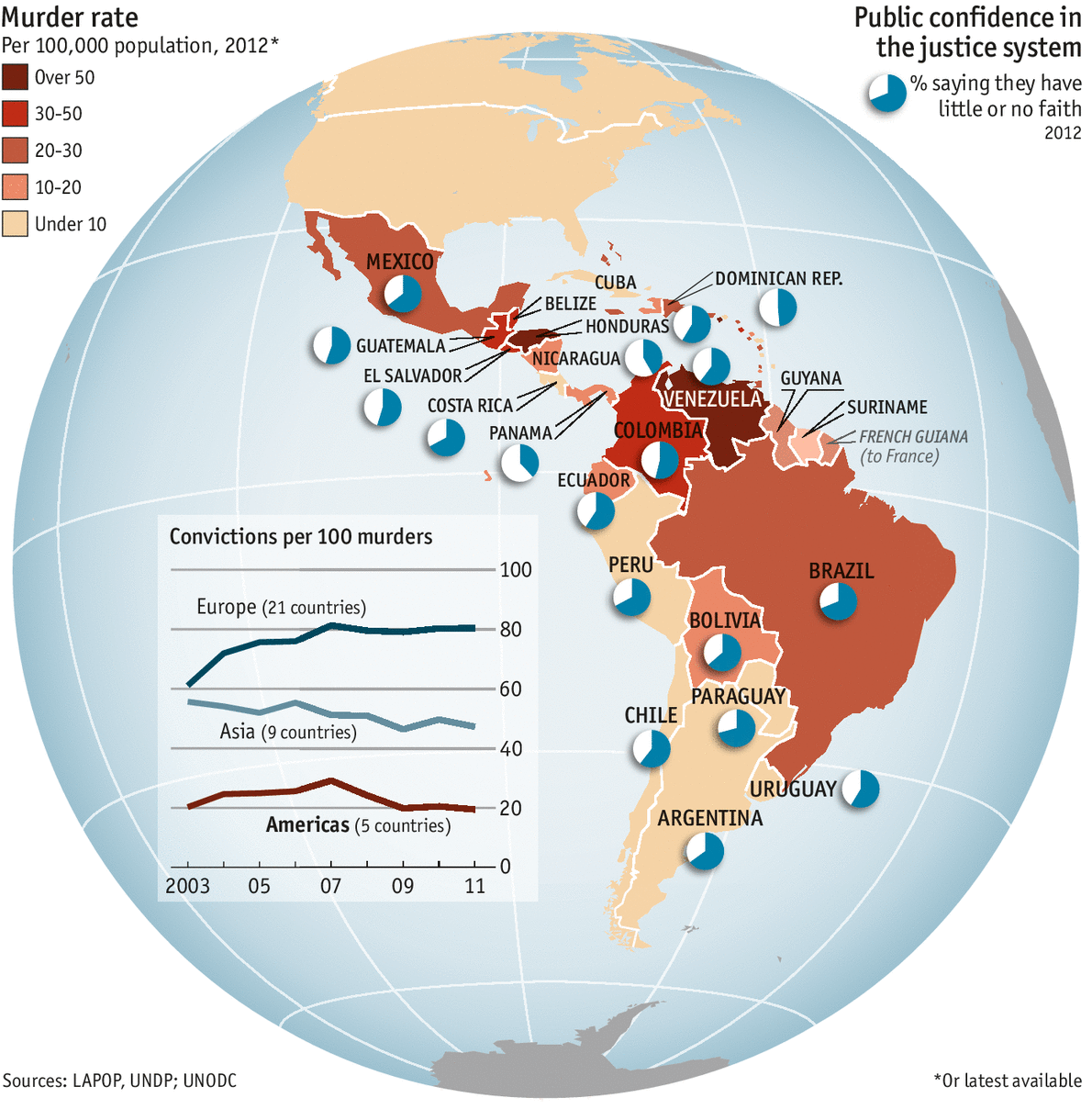
Nicaragua’s police force is in danger of giving socialism a good name. The country is one of the poorest in the hemisphere. Yet its annual murder rate, 11 per 100,000 people, is among the lowest in Latin America and eight times lower than in neighbouring Honduras (see map).
Few countries would want to reproduce the history out of which that success was born: the National Police is a product of the 1979 Sandinista revolution and civil war. But some of its best practices are easy to copy. The force requires community approval for each of its new recruits, who enjoy at least a year’s obligatory training at a police academy, smart uniforms and a strong esprit de corps that policemen say makes low pay easier to bear. In the continent most scarred by crime, such lessons are too important to ignore.
According to the UN Development Programme (UNDP), Latin America is the only region in the world where murder rates increased in the first decade of this century. Robberies have nearly trebled over the past 25 years; extortion is growing fast. So fed up are clothing businesses in Gamarra, the centre of Lima’s rag trade, with paying an average of $3,000 a month to extortionists that they held a conference in June to publicise the problem.
Plenty of factors explain Latin America’s crime disease. The external demand for cocaine, and attempts to suppress the drug trade, prompted the spread of organised criminal mafias; growth in domestic consumption of drugs has since compounded the problem. A bulge in the number of young men, many of whom are poorly educated and command low wages in the legal economy, is another factor. So is income inequality. The ubiquity of firearms means that crime is often violent.
But none of these is more important than pervasive weaknesses in the basic institutions of the rule of law—the police, the prosecutors, the courts and the prisons. Trust in the criminal-justice system remains low: majorities of the population in almost every country in the region have little or no faith in it. Criminals act with impunity. The global rate for homicide convictions is 43 for every 100 murders; in Latin America it is close to 20.
As ever, regional aggregates mask wide variations. Honduras is the region’s most violent country: at present homicide rates, a boy born there today has a one-in-nine chance of being murdered. Peruvians feel least secure, according to a 2012 poll by the Latin American Public Opinion Project (LAPOP), based at Vanderbilt University in Tennessee. The police there are allowed to double as private security guards under a scheme in which they work one day on and then one day off. With the complicity of corrupt senior officers, many police work 20 to 25 days a month privately, according to Gino Costa, a former interior minister. (One of his successors, who wanted to reform the practice, was sacked last month.)
At the other end of the scale, in a 2008 poll only 11% of Chileans felt an attempt to bribe a local policeman would be successful, far fewer than in any other country. “It’s almost impossible to bribe a Chilean policeman,” says Marta Lagos, director of Latinobarómetro, a pollster. “Say what you like about them—they might be inefficient, lazy, heavy-handed, whatever—but they’re not corrupt.” Colombia’s police force has had considerable success in reducing the prevalence of armed conflict and the drug trade. Since 2009 they have been training other forces from around the region on riverine operations, managing informants, extortion investigations and the like.
But these countries still have their problems. If Colombia has become a model to learn from in major crimes, the country’s on-the-street policing has lagged behind. Every 30 seconds in Colombia someone has their mobile phone stolen; but only one out of every 65 victims of this crime ever reports it to the police. Chile’s police may not be corrupt but almost a third of its citizens say their neighbourhoods are affected by gangs, according to a LAPOP poll. Everyone has something to learn.
In the realm of policing, the lessons embodied in Nicaragua’s police force are the most valuable. Instead of mano dura, or the militarised iron-fist policies of its northern neighbours, it offers a “friendly hand” to prevent similar levels of gang penetration. Instead of jailing wayward youths, it offers them counselling, education and job opportunities. In one slum policemen are to be found clapping along awkwardly with baggy-clothed breakdancers.

From Nicaragua
(505) 2270-6400
From the U.S.
(786) 245-8902
This email address is being protected from spambots. You need JavaScript enabled to view it.