


Why Invest in Nicaragua
Investment Opportunities
Select the sector of your interest


Success Story
Rain
Discover how the digital advertising creatives behind PepsiCo decided to expand their offices to Nicaragua. Andrew Howlett, Chief Digital Officer and one of the partners of RAIN, talks about their investment experience in the country.
Abundant Human Capital
The Nicaraguan workforce is young and dynamic, as 76 percent of the population is under the age of 39 and the labor force, comprised of 3.2 million people, is known to be flexible and highly productive, with good working habits and fast learning skills.
These qualities have allowed Nicaragua to position itself as one of the most competitive and productive in the region in terms of human capital.
Education
The Government of Nicaragua strongly believes in education as a foundation for the economic development of the country. Therefore, they assign a significant amount of the national budget in order to invest in elementary, secondary, and higher education. Expenses in education, including public universities, amount up to the 21% of the national budget.
As a result of a literacy campaign developed by the Government in 2007, under the name “yo si puedo”, it was possible to reach a general index of 96.7% product of this campaign, on august 2009 Nicaragua was declared by the United Nations Educational, Scientific and Cultural Organization (UNESCO) as a “Territory free of illiteracy” for having a rate under 4%. In 2012, the Central Bank of Nicaragua reported a literacy rate of 97 percent.
Higher and Technical Education
In the country, there were 56 higher education institutions recognized by the National Council of universities (CNU, for its acronym in Spanish) by 2013, which 46 of them has an estimated total enrollment of over 171,000 students, according to an independent study carried out by PRONicaragua. Additionally, there is a university certified by the United States of America and three bilingual university programs.
Another study made by the agency in 2013 shows that there were 396 private formation centers registered in the Technologic National Institute (INATEC, for its acronym in Spanish). Additionally, this institution has 43 own formation centers. In 2013, there were more than 136,000 enrolled students in fields such as electronics, computing and sciences, agroforestry, construction and business related services.
INCAE Business School, a prestigious regional business school affiliated with Harvard University, is located on the out skirts of Managua. The institute is ranked as number one in Latin America and trains experts in international management, ready to offer its services to world-class companies.
English Skills
Although the official language of Nicaragua is Spanish, English is increasingly popular. For historical reasons, there is a cultural affinity with the United States; the country is also experiencing the “return of brains and talent” phenomenon, where a large group of people who emigrated in the past have returned to Nicaragua, bringing with them the English language skills and international business experience.
According to a study carried out by PRONicaragua about the Spanish and English speaking population, showed that the interest of Nicaraguan in speaking English as a second language is growing fast. The results of the study showed that in 2013, there were almost 23,000 students learning English in public and private language centers; furthermore, almost 9,300 students finished the study program. In addition to the population in public and private language centers, there were 226 students enrolled in bilingual secondary schools and more than 4,000 students enrolled in universities that offer degrees in English, pedagogy in English or the classes are taught in English.
Labor Force
Nicaragua's population is characterized as flexible, with good work habits, fast learners and low rates of absenteeism and turn over. This has allowed Nicaragua to be one of the most competitive and productive nations of the region in terms of human capital.According to the Nicaragua Central Bank figures, the country’s labor force is stood in 3.2 million.
According with statistics of the Nicaraguan Institute of Social Security (INSS for its acronym in spanish), the number of ensured members have substantially increased in the past few years, going from 471,856 in 2007 to 675,426 in 2014; an increase of 43%.
Types of labor days
- Day shift: Work undertaken between six in the morning and eight at night is considered a day shift. Regular day shift hours are 8 working hours daily for a 48-hour work week. Additional work must be compensated as overtime.
- Night shifts: Work undertaken between eight at night and six in the morning of the following day is considered a night shift. Regular night shift hours are 7 working hours daily for a 42-hour work week. Additional work must be compensated as overtime.
- Combination day-night shifts: A combined work shift is 7.5 hours per day for a 45-hour work week. Additional work must be compensated as overtime.
- Overtime: Work outside regular working hours is always considered overtime. According to the National Labor Code, overtime is paid double the amount stipulated for regular working hours. A maximum of 3 hours beyond regular hours may be worked, not exceeding a total of 9 hours per week.
Labor Market Stability
The Economist Intelligence Unit in its 2015 Labor Market Risk Index, ranks Nicaragua as the second country in Central America with more stability in its labor market, due to low levels of absenteeism and turn over reported by firms.
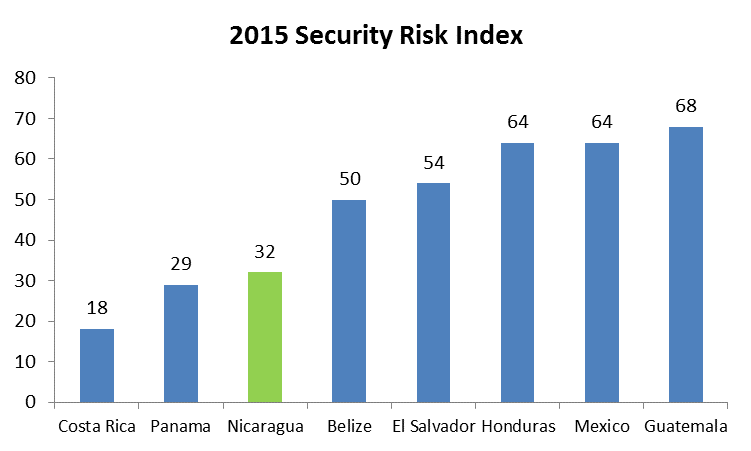
Source: The Economist Intelligence Unit, 2015.
Minimum Wage
The minimum wage in Nicaragua is characterized as the most competitive at the regional level. Wages in different economic sectors range between US$0.83 to US$1.86 per hour. Fringe benefits represent 48% aditional to the minimum wage, these include: social security, contribution paid by the employer to the National Institute of Technology (INATEC), payment of vacations and Christmas bonus, among others.
The following is the minimum wage according to the law in 2015:
Minimum Wage by Economic Activity
|
Sector |
Monthly in US$ |
Hourly in US$ |
|
Agricultural* |
173.05 |
0.83 |
|
Fishing |
263.13 |
1.26 |
|
Mines and Quarry |
310.79 |
1.49 |
|
Manufacturing Industry |
232.69 |
1.12 |
|
Free Zone Regime Industry |
234.81 |
1.13 |
|
Micro and Small Craft Industry and National Turism |
187.73 |
0.90 |
|
Electricity, Gas and Water, Commerce, Restaurant and Hotels, Transport, Warehouse and Communications |
317.41 |
1.52 |
|
Construction, Financial Establishments and Insurance |
387.27 |
1.86 |
|
Community Social, Domestic and Personal Services |
242.60 |
1.16 |
|
Central and Municipal Government |
215.80 |
1.03 |
Exchange Rate: 27.26, 2015 average. Fringe Benefits are included.
Source: Ministry of Labor (MITRAB), Valid from September 2015. Free Trade Zones valid from January 2015.
With respect to companies that are under the free zone regime, the minimum wage is the most competitive at the regional level, which makes Nicaragua an ideal country to set up labor-intensive operations.

Source: Ministry of Labor of each Country, 2015.
You may also like

Subscribe to our Newsletter
Investor's Kit
Add documents to your investor's kit by clicking on the "add to kit" button. Click here for more information.
0 documents in your kit